
Lessons from Jasper: Why Small Body Adjustments Make a Big Difference
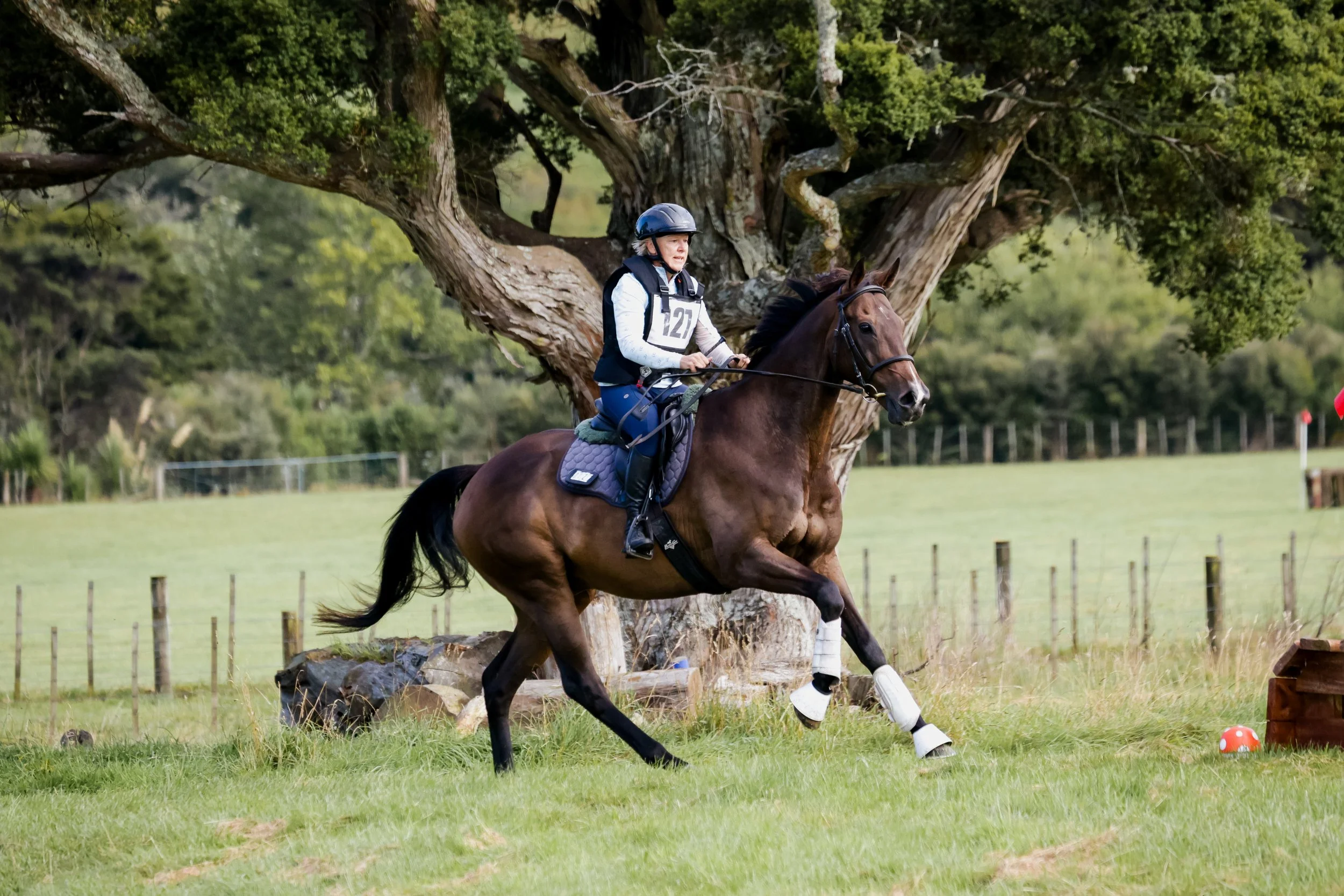
Photo Credit: CLG Photography : Jasper at Brookby Horse Trials
If you are human and ride a horse or a pony, most likely neither you nor your horse is symmetrical.
Why does this matter, you may ask?
If you are trying to progress in your riding, be a better rider for your horse or pony, improve their training to go up the levels, stay safe, have fun, or go out hacking—having the ability to give clear, understandable cues will help them decipher what you are trying to get them to do, what action you are wanting them to take, what movement you are wanting them to do, what speed you are wanting them to move at and in what direction.
You might ask how you and your horse or pony became asymmetrical: life, emotions, injury. Like our horses, we are very good at coming up with compensatory movement patterns that served us well at the time but might not be useful to us in the long run, for soundness and longevity.
Remember, in the wild, it’s the weakest that get picked off first by the predators; by the time your horse or pony shows you an unsoundness or lameness, they might have been hiding it from you for some time.
Getting back to rider symmetry and why it matters.
Your horse can feel a fly he or she can definitely feel if you have a few more kilograms or milligrams in your one foot or your seat bone, compared to the other.
For example, if you collapse or squish your left side more than your right side, you might notice that your left shoulder is lower than your right shoulder; chances are, you might have more weight in your right seat bone, and possibly you will pull, or have a stronger rein contact in your left hand; your left knee might even pop up a little higher than your right, and this pattern could be accentuated when you ask your horse to circle to the left.
As a result of your movement/response pattern in your rider body, your horse might fall out on the circle, which can be very frustrating for you and your horse!
But remember I also mentioned that your horse is probably not symmetrical either; the challenge here is that he or she doesn’t know how to become more symmetrical, and remember, for your horse, their movement pattern could have meant “survival”/less pain. You will need to be mindful and progressive in your training to change his or her movement pattern. Possibly a team approach: vet, bodywork professional, farrier/trimmer, etc.
Movement patterns aren’t bad, but it does depend on what you are asking your horse to do; if you want to do a Grand Prix Dressage Test or jump higher than 80cm, then that’s different to having a horse sound and fit enough to carry you as a rider for an hour-long hack on a flat, good ground surface.
Being aware of your body patterns is very empowering. When you have the awareness, you are able to problem-solve; you are able to interpret what information your horse is feeding back to you via his or her body language, movement patterns, restrictions, and brace.
Being aware of what happens to your body when you are riding in a walk, trot and canter, straight lines, curved lines, and lateral movements, in both directions.
Being aware of how your body responds to your horse's speed, and when you adjust stride length within a gait.
Being aware of what happens in your body when you ask for upward and downward transitions.
Being aware of what happens in your body when you are jumping, when you are coming into the jump, how it responds when you turn towards the jump, what happens when your horse speeds up or slows down, what your position is like over the jump.
Being aware of whether it is easier to go left or right after the jump, do you struggle with flying changes in one direction compared to the other?
Oh, and by the way, your body and mind work together, not in isolation.
The emotion stirred up in you will have an impact on how you respond. Consciously and unconsciously.
Your body language can reveal heaps about how your subconscious feels about the situation.
And this is the same for your horse; he doesn’t pause for too long to think about whether he should run away from the scary thing; he runs first, and then when he has a bit of distance, he might turn to look back at the scary thing!
As horse riders, handlers, trainers, custodians of our horses, it is our responsibility to build emotional resilience and regulation in ourselves and our horses.
Anyhow, that’s another chat point; let’s get back to rider body awareness.
And what your horse is trying to feed back to you.
If you were to split yourself into a more or less equal left side and a right side. From your feet to your head and everything in between.
What differences do you notice between your two sides?
Are you left-hand dominant or right hand?
Which side of your body is stronger or weaker?
If you were to kick a ball, which foot would you stand on, and which foot would you kick the ball with?
Can you stand on one leg and do a low squat? Which side is easier, and which is more challenging?
Is one shoulder carried higher than the other?
Does one of your feet turn more out than the other?
If you were to sit on a hard surface, do you naturally have more weight in one seat bone when compared to the other?
And the list continues…
If you were to do the same to your horse, what do you notice?
Is it easier for them to travel in a clockwise direction or anticlockwise?
Do they bend easier to the left or right?
Do they find it easier to do the left canter transition vs the right canter transition?
What feedback is your horse giving you when you ride?
Do you know how your natural patterns might be influencing your horse and how to problem-solve to improve the situation?
Reducing frustration and improving clarity of communication and understanding.
Are you able to be curious and experiment?
What happens if you place a few more milligrams of weight into your right seat bone or foot? What happens if you rotate your body a few more degrees in the opposite direction?
How does your horse respond?
Let me share what Jasper helped me understand a little more in depth yesterday in our ridden session.
I focused on the nuances of what might be causing the disparity between the bend, movements and exercises on the left rein (anticlockwise direction) vs the right rein (clockwise direction)
Our competition season is about to start, all things being equal!
And I want to do a deeper dive into what is going on and how, if, I can improve what I do to enable Jasper to do what he needs to do, to be more balanced, improve suppleness and bend.
I have a pretty good idea and awareness of both Jasper and my body movement preference patterns. I also know what Jasper will need to do to travel on a circle or through a corner, and which of his legs will be carrying more weight, which will be pushing and bending more to improve suppleness and bend.
Our challenge, my challenge, is on the left rein (anticlockwise direction); this isn’t an uncommon situation in the horse: rider population.
Getting back to me, the question I have is: Am I the one blocking the left bend in Jasper?
What happens if I enable my body to have a similar feeling that it does in the other direction, right rein?
When Jasper and I are travelling on the right rein, I can feel my pelvis swinging more to the outside of the bend, the curve, following the rhythm of Jasper’s rib cage swinging. It feels natural and easy on the right rein; the right bend feels like it’s from Jasper’s poll through to his tail. He feels like he is “wrapped” around my inside thigh, sadly not so much on the left rein!
So I got more curious and experimented more, changing direction often to remind my body what it felt like in the easier direction, emphasising the movement of my pelvis in the trickier direction, angling my “box-like” torso a few degrees in the other direction, experimenting with lightly using the inside bony knobble of my left ankle to see if I could encourage Jasper’s inside hind leg to step a little more towards his centre of mass. Exploring what would happen if I placed a few more milligrams of weight into my right seat bone.
And with a little bit of curiosity, experimentation and embracing the weird feelings of feeling wrong, we got closer to feeling that the bend was similar, not so different between the two sides!
Why do we get the weird feelings, the feelings, feedback, of being wrong when we change something in our riding?
Because when we do something different, the brain starts to pay more attention. It pays more attention to check that what you are doing is still going to keep you safe; it’s doing its job. Just because it feels weird doesn’t mean to say it’s wrong; it’s just new.
Your horse will probably let you know if you are on the right track with the changes you are making. If you are on the right track with your adjustments, your horse will start to show signs of meeting your expectations. Understanding what you are asking vs being confused by the “noise” of your asymmetry.
The devil is in the details - you need to address the small stuff to make the big picture happen: achieve the goals and aspirations, improve the clarity in the communication and understanding between you and your horse. Improving, achieving, harmony.
Be Curious
Experiment More
Be Open to Learning
Have more awareness
Pay attention to the small stuff